Every Employee Trained, Documented, and Compliant Across Every Location


.webp)
.webp)



Why HR Compliance Breaks Down at Scale

What Changes When HR Compliance Goes Digital
From Policy to Proof Across Every Location


What Teams Actually Use KNOW For
What OurCustomers Say




Frequently Asked Questions
HR compliance refers to the process of ensuring an organization follows all applicable employment laws, labor regulations, and internal policies across its workforce. For multi-location businesses, this includes tracking mandatory training completion, collecting policy acknowledgments, maintaining consistent time and attendance records, and ensuring documentation is in order at every site. KNOW supports HR compliance by digitizing these operational requirements and making them trackable from a centralized dashboard.
An HR compliance checklist is a structured list of documentation, training, and policy requirements that must be completed for every employee. Common items include signed offer letters, policy acknowledgments, completed mandatory training, emergency contact forms, and tax documents. KNOW lets HR managers deploy standardized checklists for onboarding, offboarding, and recurring compliance tasks across all locations, tracking completion digitally.
The most common issues are incomplete training records, missing policy acknowledgments, inconsistent time and attendance tracking, and expired certifications. These gaps are difficult to detect across multiple locations without a centralized system. A single missed training record or unsigned policy at one site can create significant exposure during an audit or employment dispute. KNOW addresses these by centralizing all compliance documentation and tracking.
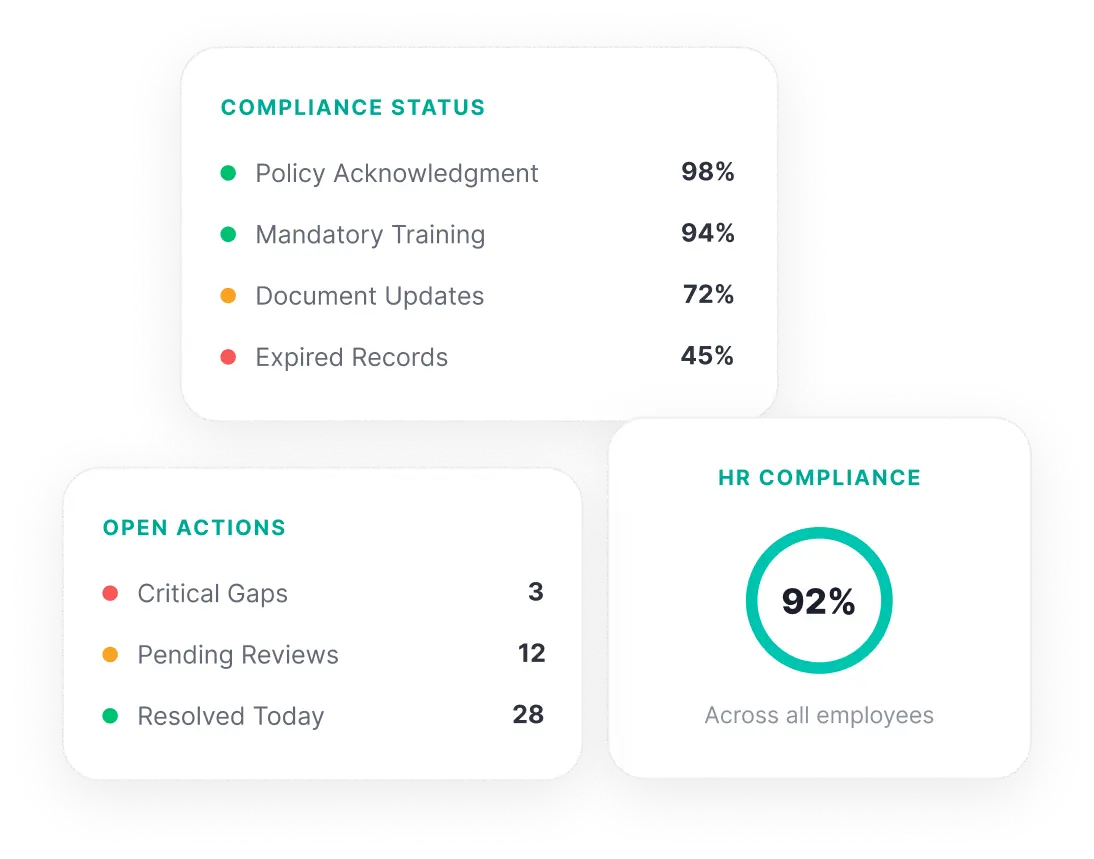
Compliance tracking is the process of monitoring whether employees have completed all required training, signed all necessary documents, and met all regulatory requirements. In multi-location operations, this means tracking compliance status for every employee at every site. KNOW provides a centralized dashboard that shows training completion, pending acknowledgments, and documentation gaps across all locations.
Workforce compliance means ensuring every employee meets the organization's regulatory and policy requirements: mandatory training, signed acknowledgments, valid certifications, and proper documentation. For frontline operations, this also includes consistent time tracking to maintain wage and hour compliance. KNOW helps maintain workforce compliance by providing the tools to assign, track, and verify these requirements digitally across every location.
HR compliance training covers the mandatory courses employees must complete to meet regulatory and organizational requirements: harassment prevention, workplace safety, food safety, anti-discrimination, and company-specific policies. KNOW's LMS assigns training modules to employees, tracks completion with timestamps, and flags overdue items. Managers can see completion rates across all locations from one dashboard.
Measure it by tracking completion rates for mandatory training, policy acknowledgments, onboarding checklists, and certification renewals across every site. Without a centralized system, this requires manually collecting records from each location. KNOW automates this by aggregating all compliance data into one dashboard, showing which locations and employees are compliant and where gaps exist.
Examples include mandatory harassment prevention training, workplace safety training (OSHA), food handler certifications, signed employee handbooks, policy acknowledgments, proper employee classification records, consistent time and attendance documentation, and offboarding checklists. KNOW helps organizations manage these by digitizing forms, deploying training through the LMS, and tracking completion centrally across all locations.
Examples include mandatory harassment prevention training, workplace safety training (OSHA), food handler certifications, signed employee handbooks, policy acknowledgments, proper employee classification records, consistent time and attendance documentation, and offboarding checklists. KNOW helps organizations manage these by digitizing forms, deploying training through the LMS, and tracking completion centrally across all locations.
An HR compliance audit is a review of whether an organization's workforce documentation, training records, and employment practices meet regulatory and internal policy requirements. Auditors typically check for completed training records, signed acknowledgments, valid certifications, and consistent time and attendance documentation. KNOW keeps all of this centralized and retrievable from one dashboard, so when an audit happens, HR managers can pull complete records across all locations instantly instead of collecting paper from individual sites.
An HR compliance audit is a review of whether an organization's workforce documentation, training records, and employment practices meet regulatory and internal policy requirements. Auditors typically check for completed training records, signed acknowledgments, valid certifications, and consistent time and attendance documentation. KNOW keeps all of this centralized and retrievable from one dashboard, so when an audit happens, HR managers can pull complete records across all locations instantly instead of collecting paper from individual sites.
The four stages are awareness, implementation, monitoring, and improvement. Awareness involves identifying which laws and regulations apply. Implementation means putting policies, training, and documentation in place. Monitoring tracks whether employees are meeting requirements. Improvement addresses gaps and updates processes as regulations evolve. KNOW covers the implementation and monitoring stages for frontline operations: deploying training, distributing policies, tracking completion, and surfacing gaps across locations from a centralized dashboard.
KNOW provides standardized onboarding checklists that deploy to every location, ensuring every new hire completes the same documentation, mandatory training, and policy acknowledgments before their first shift. Each step is tracked digitally with timestamps. HR managers can see which new employees have completed onboarding and which have outstanding items, across all sites, without contacting individual locations. This reduces the risk of employees starting work without required compliance documentation in place.
Managers can set up recurring reminders for certifications, food handler permits, and professional licenses that require periodic renewal. When a renewal date approaches, the assigned employee and their manager receive alerts. Completion is tracked digitally, so HR has a centralized record of which employees have valid certifications and which are expired or approaching expiry. This prevents compliance gaps from forming silently between audit cycles.
Non-compliance can result in regulatory fines, wrongful termination claims, wage and hour lawsuits, failed audits, and reputational damage. For multi-location operations, the risk multiplies because a compliance gap at any single site creates exposure for the entire organization. The most common issues are incomplete training records, missing policy acknowledgments, and inconsistent time tracking. KNOW reduces this exposure by making compliance requirements trackable and verifiable across every location from one platform.
Statutory compliance refers to obligations set by law, such as minimum wage requirements under the Fair Labor Standards Act, workplace safety standards under OSHA, and anti-discrimination protections under the Civil Rights Act. Regulatory compliance covers rules set by government agencies that enforce those laws, including reporting requirements, record retention periods, and documentation standards. Both require consistent tracking across all locations. KNOW supports this by maintaining centralized digital records of training, documentation, and time tracking that can be retrieved for any regulatory or legal review.