
GPSAttendance Tracking: Accurate Clock-Ins Across Every Location


.webp)
.webp)









Why Attendance Tracking Fails at Scale

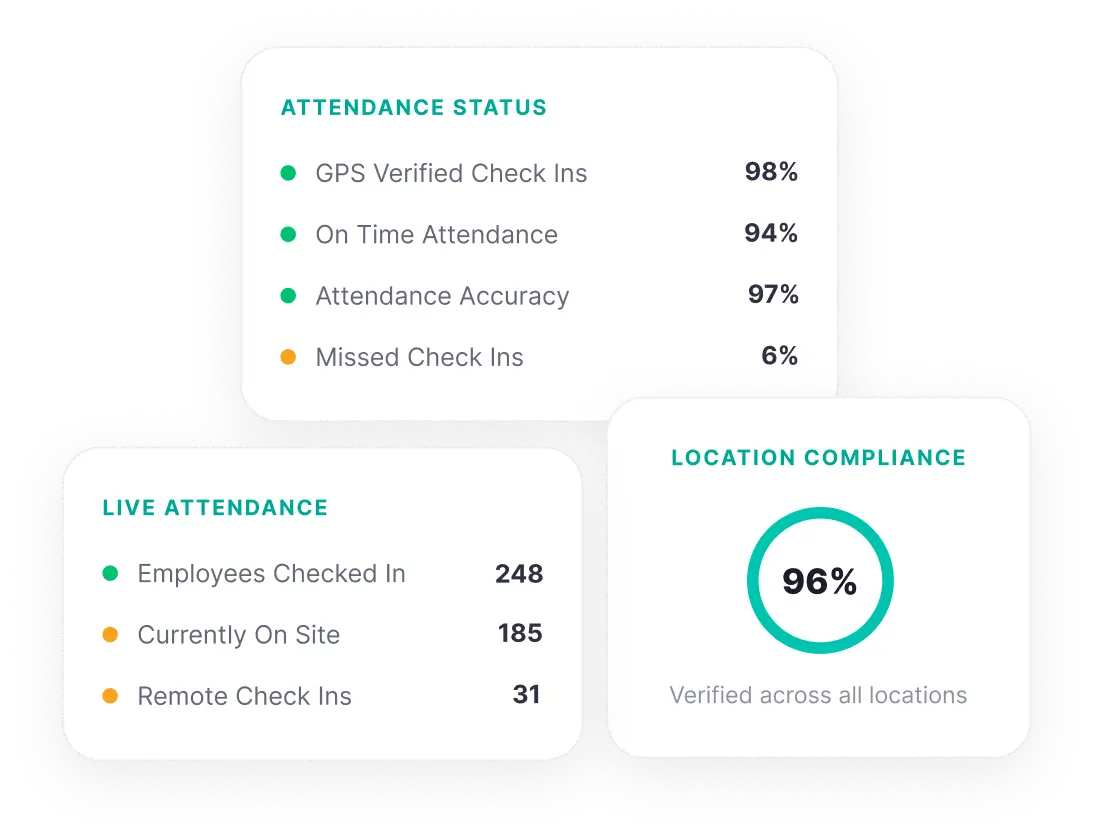
What Changes When Attendance Goes GPS-Verified
From Clock-In to Verified Record

What Teams Actually Use KNOW For
What OurCustomers Say




Frequently Asked Questions
A GPS-based attendance system uses the GPS on an employee's mobile device to capture their physical location when they clock in and out. This verifies that the employee is actually at the designated job site, preventing buddy punching and time theft. KNOW's GPS attendance app records location data with every clock-in, creating verified attendance records across all locations.
Geofencing attendance uses virtual boundaries drawn around a work location. Employees can only clock in when their mobile device is within the geofenced area. If they try to clock in from outside the boundary, the system prevents it. KNOW supports geofencing so managers can define the allowed clock-in radius for each job site.
Buddy punching is when one employee clocks in on behalf of another who is not physically present. GPS attendance prevents this by capturing the location of the device at clock-in time. If the device is not at the designated job site, the clock-in is flagged or blocked. Combined with geofencing, this ensures that only the person physically present at the location can record their attendance.
Field employees work at various job sites rather than a fixed office, making traditional time clocks impractical. KNOW's GPS attendance app lets field workers clock in from their mobile device at any location. GPS captures their coordinates at clock-in, verifying they are at the assigned site. Managers see all field employee clock-ins on a centralized dashboard in real time.
Rules vary by jurisdiction. Many employers use GPS for work-related attendance when employees are clearly informed and the use is limited to clock-in and clock-out verification. Organizations should confirm local labor and data privacy requirements before rollout. KNOW captures location data only at the moment of clock-in and clock-out for attendance verification, not continuous location tracking of employee movements throughout the day.
Many labor laws require employers to maintain accurate time and attendance records, particularly for hourly and non-exempt employees. These records support wage and hour compliance and can be required during labor audits. GPS-verified attendance provides more accurate records than manual tracking, helping organizations stay compliant with record-keeping requirements.
Yes. KNOW's mobile app works offline. Employees can clock in at remote locations or areas with limited connectivity, and the attendance data, including GPS coordinates, syncs to the central dashboard when the device reconnects. No clock-in data is lost due to connectivity issues.
Manual attendance records introduce errors through illegible handwriting, missed entries, and transcription mistakes. GPS attendance eliminates this by recording exact clock-in and clock-out times with verified locations automatically. This reduces the manual reconciliation that payroll teams perform every cycle and cuts disputes over hours worked.